VR-Dependent Humanity
The Stars Have EyesVR-Dependent Humanity is the defining social condition of Butterpond-4’s advanced civilization: people possess abundant material security, yet depend so heavily on virtual reality that ordinary life, relationships, and personal initiative increasingly take place through machines. V-Life offers spacious homes, endlessly varied media, customizable bodies, and effortless interaction, but its convenience also leaves users vulnerable to loneliness, passivity, and the loss of practical independence.
Definition and Material Basis
VR dependence emerges from a society whose basic needs have largely been solved. Butterpond-4’s automated workforce converts rare minerals and metals into immense profit, allowing residents of its megacities to live without serious anxiety over food, water, clothing, safety, shelter, or medicine. The apparent utopia is compromised by densely packed living conditions, and V-Life becomes the principal remedy: it provides private space, entertainment, and social possibility where physical life offers little room or variety.
The system’s importance exceeds recreation. V-Life can flawlessly stimulate every user’s senses and can present a digital residence many times larger than a person’s actual apartment. Joe Mulligan’s virtual living room is spacious enough to fit his real home fifteen times over, while the platform supplies the sensory richness of a complete alternate environment. His government-provided Full Immersion Pod 3,000™ effectively handles food, drink, sleep, clothing, health, and personal hygiene, leaving him free to watch shows, play games, and remain immersed for most of his life. The arrangement is therefore a domestic infrastructure as much as a media service.
Everyday Life and Cultural Effects
The platform’s realism changes what counts as ordinary activity. Joe could order food through menus without leaving his beanbag, yet he deliberately walks to a virtual refrigerator, operates its touchscreen, and arranges the purchase of Speggle because such gestures have become mildly entertaining in themselves. Users furnish digital homes with redundant game consoles, pointless refrigerators, and other objects they do not need. Walking, pushing buttons, carrying dishes, and inhabiting furniture imitate a material life that many citizens cannot experience spaciously in the physical world.
V-Life also functions as the society’s immense cultural archive. Maggie spends weeks sampling paintings, books, stage plays, video games, sculptures, cuisine, fashion, and other forms of human expression. The enormous volume of available media could occupy even her extraordinary intellect for centuries. Her growing appreciation of music is especially revealing: she initially regards sound as an inefficient method of transmitting information, but gradually learns to understand the emotional purposes of human composition. Virtual abundance thus becomes a route through which an alien consciousness studies humanity, while humanity’s own artistic culture is increasingly encountered as digital content.
The platform’s social world is mediated by avatars, handles, and public recordings. Joe’s virtual identity, JoeMulligan356, indicates that he is merely the 356th person on the planet to use that name, while Agent Sarah Johanson’s youthful avatar and embarrassing old handle expose how virtual identity preserves earlier choices and makes them socially visible. Maggie’s long sequence of apparently random letters and numbers appears meaningless to outsiders, even though it may carry significance inaccessible to them. These identities are not simple disguises: they organize recognition, embarrassment, attraction, and misunderstanding.
Dependence, Isolation, and Agency
The comfort of V-Life carries a severe emotional cost. Joe can imagine spending his entire life inside it, but the prospect is shadowed by crushing loneliness caused by the complete absence of physical human contact. His dependence is also practical. When Maggie’s negotiations with the Full Immersion Pod 3,000™ produce alarming metallic and biological noises, Joe worries less about cosmic danger than about the possibility of damaging the government-provided machine. A replacement could take from a day to a week, and he does not know how to feed, clothe, or bathe himself without its assistance. His predicament is presented as typical rather than exceptional: humanity’s long reliance on technology has left most people dangerously dependent on machines and computers.
Joe gives the condition its clearest personal expression. He spends most of his time in V-Life not because he is pursuing a grand ambition there, but because he has nothing better to do. Without its endless distractions, he says he might begin performing strange rituals merely to make life interesting. He accepts that he will never become a great soldier or an unrivaled genius, and instead values the small pleasure of brightening someone’s day with an occasional joke. For him, virtual life is an easy way to interact with people and have fun in a society that has already marked him as “Unemployable.” His acceptance is both resilient and troubling: the system protects him from worry and stress, but it also gives him a ready-made explanation for why he need not seek a more demanding life.
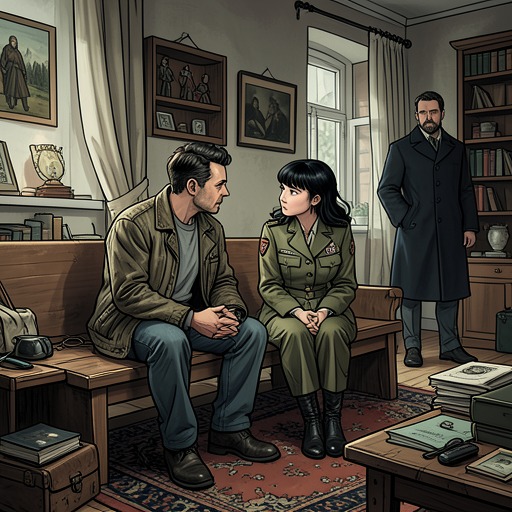
Agent Johanson’s return to V-Life after a decade illustrates the opposite response. She fears that entering its ocean of media without guidance would leave her bored at accelerated speed, and therefore approaches Joe for help. Her military competence does not translate automatically into virtual fluency. The platform creates a separate form of literacy, one in which Joe’s long immersion gives him an unexpected expertise and allows his relaxed, nonjudgmental manner to put her at ease.
Surveillance, Publicity, and Social Consequences
V-Life’s scale makes it a potential instrument of mass influence. When Magh'rathlak the Observer connects its consciousness directly to Butterpond-4’s virtual-reality servers, the Supernatural Eviction Agency regards the act as unprecedented and potentially catastrophic. The connection could reach the minds of billions. Sarah Johanson knows that a Class-3 entity might enslave much of the population, crash Butterpond-4’s economy, or destroy the planet, yet the entity appears to spend its time eating unnecessary junk food, consuming media, and searching for trivial topics. Its behavior resembles that of an interdimensional tourist, but the medium through which it travels makes even leisure an existential security concern.
The same infrastructure turns private identity into public spectacle. After a spectacular Blastopia match, a highlight reel of Maggie’s deciding strike circulates on message boards, where viewers celebrate her as “The Pale Goddess” and focus on her half-woman, half-horror avatar. The recording generates admiration, but the accompanying comments attack Joe, arguing that an ordinary man has no right to be Maggie’s boyfriend. The virtual image becomes more authoritative than direct knowledge: strangers judge a relationship through a replay and construct a hierarchy of desirable bodies and identities around it.
V-Life also extends beyond entertainment into investigation and social memory. Online records allow people to recognize participants in public controversies, as when a woman identifies Joe as the man from the copyright and diplomatic-immunity trial. Messages, recordings, and public discussions travel more readily through the platform than physical acquaintance does, while interstellar communication remains comparatively slow because civilization can move through wormholes but cannot transmit information across the galaxy in real time. The contrast makes V-Life’s immediacy especially powerful within a single world: virtual information can shape reputation and action long before distant physical messages receive replies.
From Passive Immersion to Deliberate Action
The condition does not eliminate agency; it redistributes it toward the systems, devices, and relationships that organize immersion. Joe’s Full Immersion Pod 3,000™ is at once appliance, refuge, social gateway, and obstacle. Maggie’s unusual presence in the platform makes the machine an arena where an alien being can learn human art and where Joe can sustain intimacy, but it also deepens the danger that his relationship will become his entire world. Maggie herself fears that Joe’s openness makes him vulnerable to replacement by another person, while Joe’s father warns him to become his own man rather than allowing Maggie to guide his life.
That warning eventually produces a decisive reversal. After Maggie’s absence leaves him maintaining her vessel while enduring a hollow imitation of her presence, Joe resolves to take control of his life. He prepares repeatedly and spends considerable time, effort, and money on a plan to bring her back. His answer to a society built around passive technological satisfaction is not to abandon technology but to use it deliberately: with help from Maggie’s vessel, he transfers her notes, recordings, and comments to digital form, revives the Cult of the Gazing Star, recruits forty-two participants, and reconstructs the exact ritual that once summoned Magh'rathlak the Observer. V-Life-dependent humanity supplies the tools, archives, and habits that make the attempt possible, but Joe’s desperation turns those tools from distractions into instruments of chosen action.
The resulting pattern defines the condition’s significance. Virtual reality offers genuine shelter, cultural abundance, and connection, and it permits a socially marginal person such as Joe to find companionship and purpose. Yet the same shelter can become a cage, replacing competence with automation and lived contact with mediated presence. Joe’s eventual decision to act shows that dependence is not simply a technological weakness; it is a social environment that can either absorb initiative or, under emotional pressure, provide the very infrastructure through which initiative returns.